Routing Cables in a Nuclear Reactor
This article recounts a real-world project to optimize cable routing in the Jules Horowitz Reactor, a major nuclear research facility. Traditional methods were hampered by fragmented data, manual errors, and computational bottlenecks, leading to serious delays. Our small team introduced a graph database solution that transformed the process, enabling on-demand route calculations and reducing turnaround times from weeks to minutes. Here we detail the main challenges encountered and the strategies that ensured success.
Introduction
How does one begin computing routes for cables in a nuclear reactor? By responding to public market tenders in one's spare time. In 2023, I encountered a compelling challenge: optimizing cable routing within the Jules Horowitz Reactor.
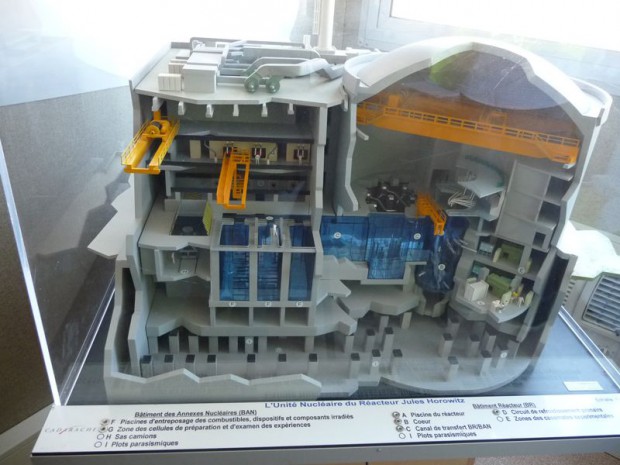
Objective
Modeling teams were responsible for determining viable cable paths throughout the reactor. Their work produced detailed 3D models, such as the following:
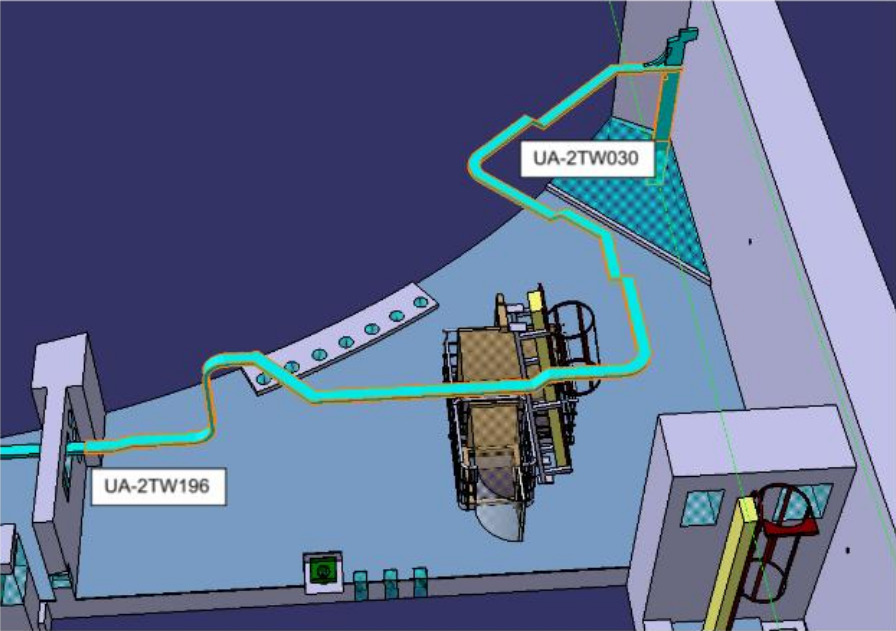
Cable trays—depicted as turquoise tubes spanning between walls—were modeled as sequences of segments. Each segment consisted of multiple points with coordinates (x, y, z) and associated metadata:
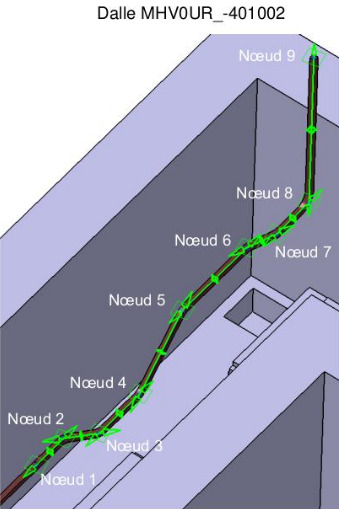
These points were stored in Excel spreadsheets and Microsoft Access databases. However, this approach presented several critical limitations:
- Data was fragmented across multiple teams, each managing different reactor levels and applying inconsistent conventions for aligning junctions between sections.
- Manual data maintenance frequently introduced errors, such as missing points and "holes" that disrupted path continuity.
- Excel-based algorithms struggled to process the enormous volume of points, failing to efficiently compute paths or key properties like length and tray capacity.
These issues led to substantial project delays.
Solution
We secured the contract as the only bidder proposing a graph database solution—ideally suited to modeling complex electrical networks. The approach excelled, enabling true on-demand route computation. What previously required weeks could now be completed in minutes.
The project involved several key challenges:
- Building a team: We assembled a compact group of four highly skilled engineers.
- Navigating client team turnover: We collaborated with roughly 10 different client representatives throughout the project. Each transition required thorough knowledge transfer.
- Reverse-engineering the data model: Source files contained thousands of rows across Excel sheets and Access databases, with schemas scattered among former stakeholders. We reconstructed the underlying logical model.
- Data cleaning and completion: We developed systematic methods to detect inconsistencies, correct errors, and intelligently fill gaps ("holes").
- Designing a graph model: Mapping the 3D structure to a performant graph representation was essential for efficient queries while minimizing database costs.
- Implementing robust data ingestion heuristics: We created automated strategies—drawing on on-site expertise—to generate plausible synthetic data for incomplete sections.
- Achieving high performance: Sophisticated algorithms were needed for synthetic data generation on standard laptop hardware. We leveraged GraphBLAS [1] for intensive tasks, delegating others to the graph database.
- Ensuring flexible deployment: The full solution was packaged into Docker containers. The graph database ran in a dedicated container, accessible solely via network APIs, to meet security requirements and enable potential backend swaps for cost optimization.
Results
- Route computation for the electrical network, previously taking weeks, now completes in just minutes.
- A comprehensive graph model of the entire electrical network was built, empowering the client to address critical questions for reactor maintenance and operations.
Conclusion
This project not only delivered timely cable routing solutions for the Jules Horowitz Reactor but also showcased the transformative power of graph-based modeling for complex, interconnected systems in high-stakes environments.